


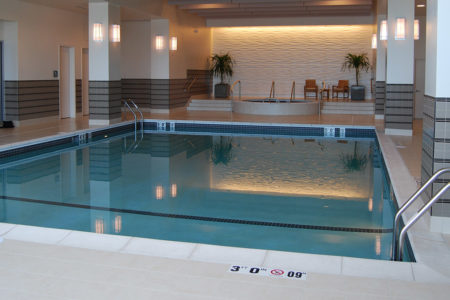
To remove chloramines from a commercial swimming pool, have the trained operator confirm the water readings and follow the treatment plan for that facility. Then check what keeps bringing the problem back: swimmer waste, a water-system fault, or air that is not moving or exhausting properly. A strong smell alone does not tell you which one to fix.
If you manage a hotel, school, apartment or municipal pool, start by assigning the investigation. The pool operator owns the readings and operating response. The facility team, pool service contractor and HVAC specialist may each own a different part of the correction. A contractor can give you a better scope when those people are working from the same log.
What are chloramines? In a pool, chloramines can form when chlorine reacts with material that swimmers bring into the water. They contribute to the combined chlorine that operators track. Some can leave the water and collect in the air above it, especially indoors. That is why the water log and the conditions at deck level can tell different stories.
Planning service or a renovation? Bring recent water logs and a description of when complaints occur to Olympic Pools in Shakopee. The team can discuss the pool work your facility needs and confirm whether it serves your location.
- What to check after a complaint
- Treatment and service responsibilities
- Records for a site visit
- Service, repair or renovation
- Questions before making a decision
What to check when you need to remove chloramines from a commercial pool
Start with the complaint’s time and location. The useful distinction is whether it appeared at the water surface, in the spectator seats, at a particular feature, or across the room. Ask whether it arose before swimmers arrived, during a busy session or after shutdown. Save the readings and operating history from that period before they are overwritten.
The CDC’s chloramine guidance explains that turbulence can increase release from the water and that inadequate fresh air and exhaust let chloramines accumulate indoors. It also explains why a unit that controls humidity does not necessarily provide adequate air exchange. Neither a dry room nor a clear pool rules out a problem.
The trained operator measures free and total chlorine together, using the facility’s approved method, and subtracts free from total to record combined chlorine. In Minnesota, rule 4717.1750, subpart 3E requires treatment when the combined residual exceeds 0.5 ppm, to bring it to 0.5 ppm or below. The CDC uses a different example threshold in its guidance; it is not the Minnesota rule or a national legal limit. Use the requirements that govern your facility.
Escalate under your facility’s safety and closure procedures when swimmers or staff report irritation or the operator cannot confirm acceptable conditions. Do not use a reading from another basin, a good-looking controller display or a quieter room as a reopening decision. The responsible operator and applicable authority determine the response.
Treatment decision table: what each measure fixes
Someone may propose a chemical treatment, an air-system visit or an equipment upgrade as the fix. Ask what the proposal would address, how the team would check the result, and what problem it leaves with the operator. At a facility with multiple commercial pools or spas, keep separate logs whenever basins or circulation systems are separate.
| Purpose | Who acts | What to verify and hand over |
|---|---|---|
| Reduce excess combined chlorine in the water | Trained operator following the applicable requirements and facility response plan | Record paired readings, response and follow-up tests. Coordinate any closure and ventilation needed for the treatment. |
| Reduce swimmer waste entering the water | Aquatics staff and facility management | Review shower access, rinse messages, restroom breaks and supervision against the swim schedule. Track what staff can consistently enforce. |
| Investigate a circulation or treatment fault | Operator and qualified pool service provider | Match controller trends and manual readings to pump and filter status, maintenance and any recent changes. Specify whether diagnosis, repair and startup checks are included. |
| Improve fresh air movement and exhaust | Facility engineering or a qualified aquatic HVAC specialist | Compare the air system’s intended and actual operation during the affected period, including occupied mode and conditions near the water and deck. |
| Evaluate supplemental UV or ozone | Pool designer or qualified equipment specialist with the operator | Review equipment condition, compatibility with the circulation system and service access. Supplemental equipment does not replace the required disinfectant residual. |
Ask the provider to put its part in writing. For example, someone who can examine a filter or a treatment unit may not be the right person to assess the air distribution in a natatorium. Use the commercial pool service guide to define who investigates, who corrects the fault and who returns the pool to use.
Five records to bring to the next conversation
- Water readings and test method. Bring free chlorine, total chlorine, calculated combined chlorine and pH, with date, time, sampling location and basin. Include follow-up readings, not just the highest number. Identify any gap in the records instead of guessing.
- Use and complaint history. Note normal use and what changed, such as a meet, a lesson block or a feature running longer than usual. Summarize where discomfort was reported and what staff did. Keep personal health details out of the contractor’s copy.
- Equipment and maintenance record. Include known models, fault messages, filter and circulation logs, service dates and work that preceded the complaint. The CDC’s public pool operating guide recommends practical water-quality records and preventive maintenance. Mark which checks are still open.
- Ventilation schedule and recent work. Identify indoor units, occupied and unoccupied periods, and any changes to controls or operating hours. Include the deck location and time where staff noticed a problem. Leave measurements and adjustments inside the equipment to qualified staff.
- Plans, responsibilities and access. Bring the available drawings and manuals, the operator and building contacts, safe access arrangements, and periods when a basin can be out of use. Discuss facility design and operating needs together when the pool and air systems interact.
A hypothetical example: the same complaint on two different days
A school records complaints after a busy Saturday meet and again during a quiet Monday practice. On one log entry the operator writes down 1.7 ppm total and 1.4 ppm free chlorine. The difference is 0.3 ppm combined chlorine, a reading at one sampling point and time. It does not measure air quality, establish conditions earlier that day, or authorize reopening.
The owner asks for the rest of Saturday’s water and use records and Monday’s air-system schedule. If the air unit was on a different schedule on Monday, that gives the HVAC specialist a specific question. If the readings rise only during heavy use, the operator can look at bather practices and treatment performance during that period. Both patterns deserve investigation; neither is a diagnosis from the log alone.
When the job is service, repair or renovation
Start with service when you need to determine why a recurring problem appears under particular conditions. If the findings identify a component that no longer performs its job, ask for a commercial pool repair plan that states what will be replaced, which systems are affected and how normal operation will be checked.
Consider a broader scope when the investigation points to enduring system limitations, not just a failed part. A project may need to coordinate the circulation and treatment equipment, building controls, electrical service, and usable maintenance access. A commercial renovation scope should name those interfaces, the people who own them, and how the work will be handed over.
If a proposal calls for different treatment equipment, compare commercial pool disinfection systems on their intended function and their actual fit to your facility. Ask for equipment manuals, service intervals, start-up responsibilities and the records you will receive. A retrofit should give the operator a workable handoff, not just a new box in the equipment room.
Olympic Pools’ construction and service experience includes work on commercial pools in Minnesota. Bring a short history and ask which parts of the job the team can handle. If HVAC design or air testing is needed, confirm who will coordinate the specialist. Plan around closures, seasonal demand and inspection needs before promising users a reopening date.
Questions before making a decision
Does a strong chlorine smell mean the pool has too much free chlorine?
No. Smell may prompt a check but does not tell you the free or combined chlorine reading. Use the trained operator’s tests along with where and when the complaint occurred.
What records should an owner prepare first?
Start with water logs, the time and place of complaints, the use schedule, and recent pool or air-system changes. Note the missing information so the team can decide what needs to be checked on site.
When is a qualified site assessment needed?
Call the responsible operator promptly about symptoms or uncertain water quality. Repeated problems, inconsistent readings or suspected ventilation faults call for qualified investigation in the affected part of the facility.
Can a ventilation repair take the place of water treatment?
No. Ventilation addresses air movement and removal. The operator still needs to meet applicable water requirements and address excess combined chlorine under the facility’s procedures.
What changes the scope of a repair?
A confirmed failed component is different from a system that cannot meet the facility’s operating needs. Ask the team to identify which finding supports each proposed item, and to separate repair from redesign and ongoing operation.
Who should receive the handoff after the work?
Give the written scope, operating instructions and follow-up plan to the responsible operator and facility manager. Minnesota pool operator training can support staff preparation; Olympic Pools explains what CPO certification covers and why the facility still needs an assigned operator.
Bring the log, not just the symptom
Before asking for a quote, put the affected basin, time of day, paired readings, use and recent system changes on one page. Call Olympic Pools in Shakopee at 952-224-2200 to discuss a commercial pool project and the records to share. Confirm your location and the scope of the visit before planning downtime.

Leave a Reply