


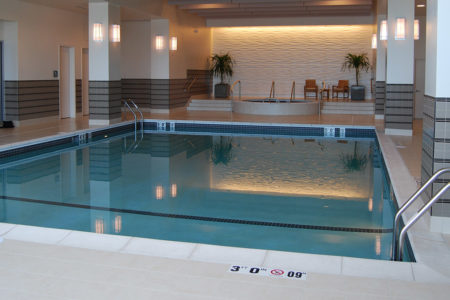
Commercial pool repair restores a specific damaged or failing part of a shared-use pool, from finishes and circulation equipment to piping and access components. A useful repair scope identifies the condition, the investigation needed, the proposed remedy and the checks required before the facility returns to service.
For a hotel, apartment community, school or municipal facility, the hardest decision often comes before the quotation: are you buying a localized repair, recurring service or a larger renovation? This guide helps owners prepare that decision without choosing a repair method before someone has assessed the pool.
Olympic Pools brings Minnesota pool design and service experience to that conversation. Bring the pool’s location, photographs, operating records and desired work window when you discuss a commercial project. Confirm project fit and geographic coverage with the Shakopee team.
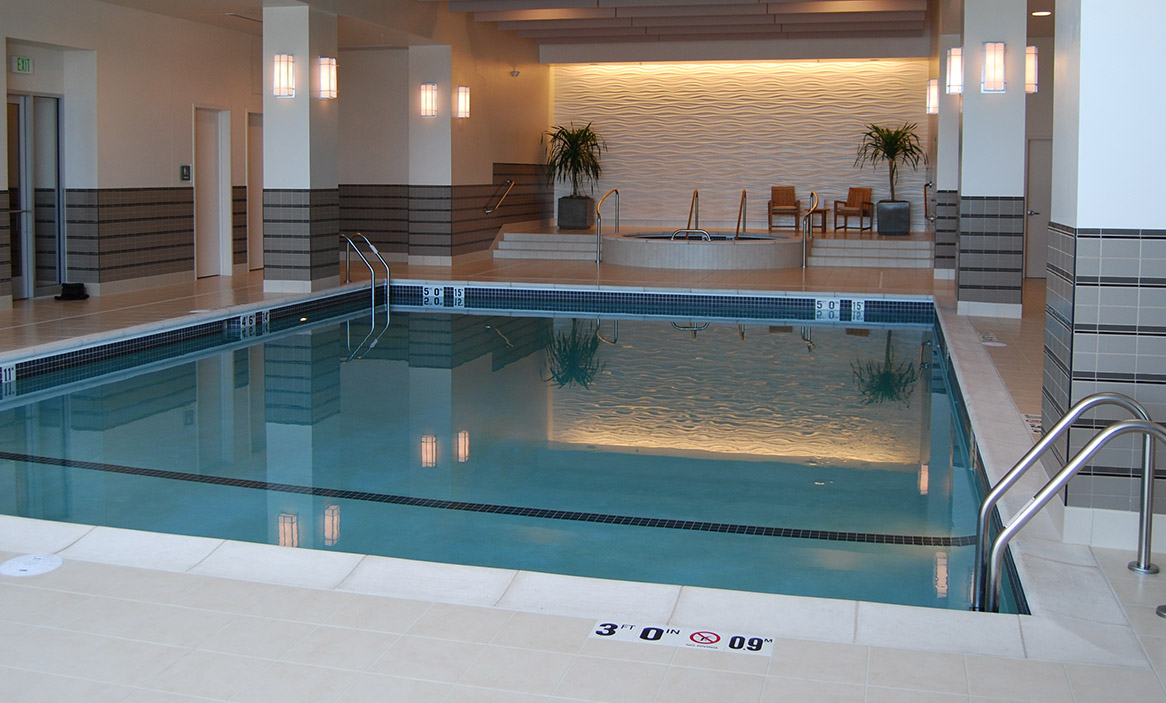
Commercial pool repair, routine service or renovation?
A repair addresses an identified defect. Routine service supports continuing operation through a defined recurring scope. A renovation changes or renews a wider part of the facility. One project can involve all three, but the owner should know which deliverable belongs to which contract.
For example, investigating a recurring pump fault is not the same purchase as a weekly operating visit. Replacing a damaged section of finish is not automatically a complete resurfacing project. Changing circulation layout while renewing the basin is broader again. Describing every need as maintenance makes quotations harder to compare and can conceal an unfinished design decision.
Use the existing guide to service responsibilities for facility teams for the ongoing operating picture. Use commercial pool renovation planning when the question extends to renewal, replacement or changes across several systems. The repair brief sits between those conversations: what failed, what is connected to it and what must be restored?
| Decision | What to define | Useful handover |
|---|---|---|
| Routine service | Visit frequency, operating tasks, records and escalation responsibilities | Visit reports, outstanding observations and the next planned actions |
| Localized repair | Defined defect, investigation, affected interfaces and acceptance checks | What changed, what was checked and what remains unresolved |
| Equipment replacement | Compatibility, controls, connections, access and commissioning | Model information, settings, manuals and operating instructions |
| Renovation | Coordinated design across the basin, finishes, equipment and surrounding area | Updated drawings, approvals, system records and a facility handover |
A repair scope and responsibility map
Start with seven connected areas. The map below is a practical way to organize a project conversation, not an inspection certificate or a prescription for a particular pool. Assign one owner contact to assemble the records and ask the proposed contractor to identify the specialist responsibilities within its offer.
| Area | Owner’s starting record | Responsibility to resolve |
|---|---|---|
| Structure | Drawings, dated photographs and a history of movement or recurring damage | Who assesses the condition and determines whether design work is needed? |
| Finishes | Location, extent, previous patches and the current surface specification | Who defines substrate preparation, compatible materials and return-to-use conditions? |
| Hydraulics | Piping plans, operating observations, available readings and prior changes | Who investigates the cause and evaluates effects on the circulation system? |
| Equipment | Model labels, manuals, fault history and service reports | Who confirms compatibility, connections, controls and commissioning? |
| Access | Equipment-room route, occupied areas, door openings and work restrictions | Who protects the site, coordinates trades and reinstates disturbed areas? |
| Documentation | Inspection correspondence, approvals, warranties and previous project files | Who obtains required reviews and supplies the final repair record? |
| Downtime | Booking calendar, closure options and staff availability | Who coordinates shutdown, startup, checks and the reopening decision? |
Read the map across, not just down. A finish problem can have an unresolved substrate issue. Equipment replacement can require changes to controls or access. Repairing a pipe may involve opening and reinstating a deck. A proposal that describes only the visible component may leave the connected work with the owner.
Prepare a useful repair brief
A contractor can investigate more effectively when the owner separates observations from explanations. Write “the alarm appeared after startup on three mornings” rather than “the controller is defective” unless that diagnosis has actually been established. Give dates, locations and operating circumstances; attach the supporting record.
- Identify the facility. Include its address, pool type, indoor or outdoor setting, owner contact and responsible operator.
- Describe the change. Explain what staff noticed, when it began and whether it is intermittent, worsening or associated with a particular operating condition.
- Gather existing drawings. Include available basin, piping and equipment-room plans, noting known alterations that are absent from the originals.
- Collect equipment information. Photograph readable labels where staff can do so safely. Keep manuals and prior service reports with the brief.
- Show the affected area. Use dated photographs and an annotated plan. Do not enter restricted spaces or disturb equipment to obtain an image.
- List earlier interventions. Include patches, replacement parts, investigations, reports and any warranty correspondence.
- Explain the operating window. Identify occupied spaces, scheduled events, closure options and the person who can authorize access.
- Name the decision needed. Ask for diagnosis, options, a defined repair proposal or a coordinated renovation assessment rather than an unspecified quotation.
Missing drawings do not make a repair conversation impossible. Say which records exist and which need to be reconstructed through assessment. The important distinction is between a known condition and an assumption carried forward from an old project.
Assess the condition before choosing the method
Owners naturally want an immediate answer: patch, replace or rebuild? The answer depends on the condition and the interfaces around it. Repeated deterioration, visible movement, unexplained operating changes or a suspected safety issue need an appropriate professional assessment rather than an online diagnosis.
Let the responsible operator handle operating restrictions and escalation under the facility’s procedures. Do not keep an apparently hazardous condition in use merely to preserve the booking calendar. Equally, do not drain the basin, alter suction components, open electrical equipment or improvise pressure testing to gather evidence for a quotation. Those are project-specific technical decisions.
Olympic Pools’ team and company background describes concrete-pool construction and service experience and attention to system design. Ask which experience matches the proposed repair. A gallery photograph or a company’s general history is a useful discussion point, not proof that a particular method suits your facility.
Check the review path in Minnesota
The Minnesota Department of Health’s public pool plan-review guidance distinguishes different alterations. Structural changes and non-localized piping or altered piping configurations are among the listed review-required projects. Localized like-for-like piping repair is listed differently. Work not requiring that review must still meet the applicable pool code; ask MDH to clarify the actual scope when needed.
The CDC Model Aquatic Health Code is national guidance, not a federal pool law. Jurisdictions decide whether and how to adopt it. A facility outside Minnesota must establish its own applicable requirements rather than treating Minnesota guidance as nationwide approval.
Compare the complete installed repair scope
A component price does not describe the full project. Ask proposals to separate investigation, design where needed, materials, labor, access, protection, removal, reinstatement, startup and required checks. Identify allowances and exclusions so two totals do not appear comparable while covering different work.
For a replacement component, request its specification and the reason it fits the existing system. For a finish repair, ask how the underlying condition and preparation will be addressed. For piping work, ask what is known about the route, material and connections. The owner’s job is to make these questions visible; the qualified project team determines the technical solution.
Use commercial pool design planning when repair options affect system interfaces. The design-to-construction process is relevant when the work expands beyond a discrete repair into coordinated construction.
A hypothetical scope comparison
Imagine an indoor facility with recurring damage beside a circulation return. One proposal covers only removal and replacement of the visible finish. Another includes investigation of the affected interface, a defined repair contingent on those findings, reinstatement and documented startup checks. The second proposal is not automatically the right technical answer, but the two offers plainly purchase different work.
Before choosing, ask what finding would change each proposal. Who authorizes additional investigation? What happens if the underlying condition differs from the assumption? Put those decision points in writing. This example illustrates purchasing scope; it is not a report of an Olympic Pools project, a diagnosis or a price comparison.
Plan the closure through to handover
Work duration and total closure are different. Include preparation, access, deliveries, any material-specific waiting periods, startup and required review in the sequence. Ask the project team to state what controls each step rather than promising a reopening date based only on the time a crew is on site.
For an outdoor Minnesota facility, discuss seasonal constraints early. For an occupied hotel or apartment building, map noise, work routes and public separation. Confirm who communicates changes to residents or guests and who can make schedule decisions when findings change the scope.
At handover, request the description and location of completed work, updated component information, relevant settings and manuals, warranty terms, recorded checks and remaining actions. Identify the person responsible for the reopening decision. A completed contractor visit and approval to return a facility to use are not interchangeable.
Connect the repair record to the operating team’s files. Olympic Pools’ Minnesota pool operator training information is a useful separate resource for staff preparation; training does not replace the repair specification or required project approvals.
Commercial pool repair questions
What does commercial pool repair include?
It can include investigation and work on a defined basin, finish, piping, equipment or access problem. The contract should identify the defect being addressed, connected work, exclusions and checks at completion. Do not assume every repair provider offers every trade or an ongoing operating contract.
What records should the owner prepare?
Bring drawings, dated photographs, operating observations, equipment labels, prior repair reports and inspection correspondence. Add the facility address, responsible contacts and access window. Label uncertainties clearly rather than turning a staff theory into a diagnosis.
How does repair differ from replacement or renovation?
A repair addresses a defined failure; replacement substitutes a component; renovation renews or changes a broader part of the facility. Replacement can be part of either. The right scope depends on condition, compatibility, design implications and the owner’s objectives.
Which conditions need a qualified site assessment?
Recurring damage, suspected structural movement, unexplained circulation changes, damaged safety components and complex system alterations need appropriate assessment. Follow the facility’s escalation procedures for suspected hazards rather than waiting for a routine quotation.
What changes the complete repair scope?
Access, investigation findings, preparation, compatible components, connected trades, review requirements and reinstatement can all change it. Ask which items are included and what findings would trigger a revised proposal before work begins.
How should service access, seasonal timing and handover be planned?
Plan backward from a realistic reopening process, not just the repair date. Coordinate access and public separation, obtain the project team’s sequence, arrange staff availability and specify the records and checks required at handover.
Start with the condition and the records
For a commercial pool repair conversation, send Olympic Pools the facility location, the observed problem, available drawings and photographs, earlier repair history and preferred work window. Call 952-224-2200 or use the commercial project page to discuss project fit. Ask the team to help define the next assessment and scope decision before committing to a particular repair method.

Leave a Reply